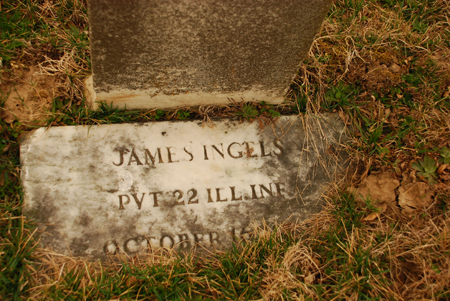
James Ingels
Born: 30 Mar 1846
Birthplace: Pomeroy, Meigs, Ohio
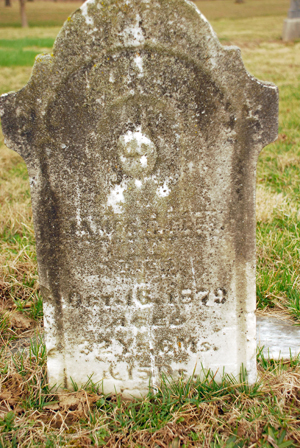
Death: 16 Oct 1879
Buried: Hazel Dell Cemetery, Bond County, IL
Spouse: Mary M. Hayman
Married: 16 Mar 1870
Father: Anson Ingels
Mother: Eleanor Dusky (Ingels)
Children: Emma M. Ingels (Denny), William J. Ingels
Birthplace: Pomeroy, Meigs, Ohio
Death: 16 Oct 1879
Buried: Hazel Dell Cemetery, Bond County, IL
Spouse: Mary M. Hayman
Married: 16 Mar 1870
Father: Anson Ingels
Mother: Eleanor Dusky (Ingels)
Children: Emma M. Ingels (Denny), William J. Ingels
Photos:
Records & Info:
American Civil War Soldiers
Name: James Ingels
Residence: Bond County, Illinois
Enlistment Date: 12 Apr 1862
Side Served: Union
State Served: Illinois
Service Record: Enlisted in Company D, 22nd Infantry Regiment Illinois.
Transferred out of Company D, 22nd Infantry Regiment Illinois.
Transferred into Company D, 42nd Infantry Regiment Illinois.
Enlisted as a Private on 12 April 1862.
Regiment: 22nd Infantry Regiment Illinois
Date of Organization: 25 Jun 1861
Muster Date: 7 Jul 1864
Regiment State: Illinois
Regiment Type: Infantry
Regiment Number: 22nd
Officers Killed or Mortally Wounded: 2
Officers Died of Disease or Accident: 2
Enlisted Killed or Mortally Wounded: 145
Enlisted Died of Disease or Accident: 101
Regimental Soldiers and History:
ILLINOIS TWENTY-SECOND INFANTRY.(Three Years)
The Twenty-second Infantry Illinois Volunteers was
organized at Belleville, Illinois May 11, 1861, and was
mustered into the United States service for three years, at
Caseyville, Illinois, June 25, 1861, by Captain T. G. Pitcher,
U. S. A.
On July 11, the Regiment moved to Bird's Point, Mo.
November 7, seven companies engaged in the battle of
Belmont--three being left to guard transports. Loss, 144,
killed, wounded and missing.
January 14, 1862, made a reconnaissance, under General
Grant, into Kentucky, in the rear of Columbus.
The Twenty-second was on detached duty a great deal of the
time, and not infrequently had single-handed engagements with
the enemy.
On August 19, Colonel Dougherty, with Companies A, B, C, D
and E, attacked Colonel Hunter at Charleston, Mo., in the
night, and drove him from his camp to the town in a hand-to-
hand fight, capturing many prisoners and horses. In this
engagement the Twenty-second lost 1 killed and 11 wounded,
including Colonel Dougherty. Whose shoulder was broken with the
butt of a gun, and Captain Johnson, who received a gunshot
through the right leg.
After this engagement, the Regiment returned to Bird's
Point.
Early in the spring of 1862 the Regiment left camp, with
one day's cooked rations, to engage General Jeff. Thompson, who
was known to be in the neighborhood in force. Coming up with
him at Sikestown, a running fight ensued, when he was driven to
his fortifications at New Madrid. In this engagement, the
Twenty-second captured two guns and a few prisoners, and
returned to camp the third day without the loss of a man.
April 8,1862, expedition to Tiptonville, under General
Paine, to intercept retreating enemy from Island No. 10.
Captured 4,000 prisoners, 2 Generals, and a large quantity of
stores, ammunition, arms and guns.
May 3, 5 and 9, 1862, skirmished before Farmington, and
battle of Farmington.
The Regiment was engaged in the siege of Corinth, and in
pursuit of the enemy two weeks, in June. The last day of the
siege Captain Johnson was again wounded, receiving a gunshot
through the head.
The Twenty-second was engaged guarding Memphis &;
Charleston Railroad until August 26, 1862, when it fell back to
Nashville by forced marches, arriving September 11, where it
remained the balance of the year.
After the return of the Regiment to Nashville, it was
besieged in the city for months without receiving communication
of any kind from the outside world, and it was forced to send
out foraging parties daily to obtain supplies.
December 31, 1862, and January 1 and 2, 1863, the Regiment
was engaged in the battle of Stone river, where it lost 199 out
of 342 men going into action.
Lieutenant Colonel Swanwick was wounded and taken prisoner,
and remained at Atlanta and Richmond (Libby) until May, 1863.
It is a singular fact, that at the battle of Stone River, every
horse belonging to the Regiment, including the Battery, was
killed.
After the occupation of Murfreesboro, the Regiment was in
camp at different points around that place, foraging and
skirmishing through the winter and spring.
Marched with the Army of the Cumberland, early in June,
southward.
Crossed the Tennessee River at Bridgeport, Alabama, about
September 1.
The Regiment was engaged in the battle Of Chickamauga,
September 19 and 20, on the extreme right of the Army under
General Sheridan, losing 135 officers and men, out of an
aggregate of less than 300. In proof of the severity of the
action on the 19th, the Regiment lost 96 men in less then ten
minutes, most of whom were down. Among others, the brave Major
Johnson was very severely wounded, and Captain French mortally.
The Regiment remained in and around Chattanooga, suffering,
in common with the rest of the army, from exposure and want of
provisions, being frequently on less than half rations, amid
almost destitute of blankets, clothing tents, etc., until the
26th of November, when, with the remainder Of General Sheridan's
Division, it was engaged in storming the heights of Mission
Ridge losing again between 30 and 40 out of the mere skeleton to
which it had previously been reduced.
The few men remaining fit for duty marched, about the last
of the month, to the relief of Knoxville.
Passed the greater part of that severe winter (1863-4) in
the mountains of East Tennessee.
Marching, in the month of January, 1864, to Dandridge, in
pursuit of the Rebel Army under General Longstreet retreating
at night, over awful roads, to Strawberry Plains, and thence
marched through Knoxville to Loudon, Tennessee, where it
remained long enough to build log huts and occupy them some
weeks; and here, March 6, 1864, received the first full ration
since leaving Bridgeport, being fully six months.
Leaving London, the Regiment marched to Cleveland,
Tennessee, and there remained until the scanty remnant joined
the grand Army of General Sherman, on the Atlanta
campaign.
The Regiment was engaged two days at Resaca, having about
20 men killed and wounded, and in all the other battles and
skirmishes, with the exception of Rocky Face (was eleven days
and nights under fire at New Hope Church), until the morning of
the 10th of June, when all but the recruits and veterans were
ordered to Springfield, Illinois, for muster out.
The Regiment was mustered out at Springfield, Illinois,
July 7, 1864. The veterans and recruits whose term of service
had not expired, were consolidated with the Forty-second Regiment
Illinois Infantry Volunteers.
It is worthy of mention here that Colonel Dougherty, having
lost a leg at the battle of Belmont, never commanded the Regiment
again after that engagement.
ORDER OF CONSOLIDATION HEADQUARTERS DEPARTMENT OF THE CUMBERLAND,
CHATTANOOGA, TENN., November 22, 1864.
Special Field Orders,
No. 320.
Extract XII. The detachment Twenty-second Illinois Infantry,
temporarily attached to Forty-second Illinois Infantry, and the
detachment Twenty-seventh Illinois Infantry temporarily attached
to Seventy-ninth Illinois Infantry, are, subject to the approval
of the Secretary of War, hereby transferred to those commands,
respectively.
By command of Major General Thomas.
WILLIAM McMICHAEL,
Major and Ass't Adjutant General
Official.
(Signed.) GEORGE W. HOWARD,
A. A. G.
WAR DEPARTMENT, ADJUTANT GENERAL'S OFFICE,
WASHINGTON, January 7, 1865.
Special Orders
(No. 10. }
XV. So much of Special Field Orders No. 320, Par. 12,
November 22, 1864, from Headquarters Department of the
Cumberland, as relates to the Forty-second Illinois Volunteers,
and the detachment of the Twenty second Illinois Volunteers now
temporarily attached to the former organization, is hereby
confirmed.
By order of the Secretary of War.
(Signed.) W. A. NICHOLS,
Name: James Ingels
Residence: Bond County, Illinois
Enlistment Date: 12 Apr 1862
Side Served: Union
State Served: Illinois
Service Record: Enlisted in Company D, 22nd Infantry Regiment Illinois.
Transferred out of Company D, 22nd Infantry Regiment Illinois.
Transferred into Company D, 42nd Infantry Regiment Illinois.
Enlisted as a Private on 12 April 1862.
Regiment: 22nd Infantry Regiment Illinois
Date of Organization: 25 Jun 1861
Muster Date: 7 Jul 1864
Regiment State: Illinois
Regiment Type: Infantry
Regiment Number: 22nd
Officers Killed or Mortally Wounded: 2
Officers Died of Disease or Accident: 2
Enlisted Killed or Mortally Wounded: 145
Enlisted Died of Disease or Accident: 101
Regimental Soldiers and History:
ILLINOIS TWENTY-SECOND INFANTRY.(Three Years)
The Twenty-second Infantry Illinois Volunteers was
organized at Belleville, Illinois May 11, 1861, and was
mustered into the United States service for three years, at
Caseyville, Illinois, June 25, 1861, by Captain T. G. Pitcher,
U. S. A.
On July 11, the Regiment moved to Bird's Point, Mo.
November 7, seven companies engaged in the battle of
Belmont--three being left to guard transports. Loss, 144,
killed, wounded and missing.
January 14, 1862, made a reconnaissance, under General
Grant, into Kentucky, in the rear of Columbus.
The Twenty-second was on detached duty a great deal of the
time, and not infrequently had single-handed engagements with
the enemy.
On August 19, Colonel Dougherty, with Companies A, B, C, D
and E, attacked Colonel Hunter at Charleston, Mo., in the
night, and drove him from his camp to the town in a hand-to-
hand fight, capturing many prisoners and horses. In this
engagement the Twenty-second lost 1 killed and 11 wounded,
including Colonel Dougherty. Whose shoulder was broken with the
butt of a gun, and Captain Johnson, who received a gunshot
through the right leg.
After this engagement, the Regiment returned to Bird's
Point.
Early in the spring of 1862 the Regiment left camp, with
one day's cooked rations, to engage General Jeff. Thompson, who
was known to be in the neighborhood in force. Coming up with
him at Sikestown, a running fight ensued, when he was driven to
his fortifications at New Madrid. In this engagement, the
Twenty-second captured two guns and a few prisoners, and
returned to camp the third day without the loss of a man.
April 8,1862, expedition to Tiptonville, under General
Paine, to intercept retreating enemy from Island No. 10.
Captured 4,000 prisoners, 2 Generals, and a large quantity of
stores, ammunition, arms and guns.
May 3, 5 and 9, 1862, skirmished before Farmington, and
battle of Farmington.
The Regiment was engaged in the siege of Corinth, and in
pursuit of the enemy two weeks, in June. The last day of the
siege Captain Johnson was again wounded, receiving a gunshot
through the head.
The Twenty-second was engaged guarding Memphis &;
Charleston Railroad until August 26, 1862, when it fell back to
Nashville by forced marches, arriving September 11, where it
remained the balance of the year.
After the return of the Regiment to Nashville, it was
besieged in the city for months without receiving communication
of any kind from the outside world, and it was forced to send
out foraging parties daily to obtain supplies.
December 31, 1862, and January 1 and 2, 1863, the Regiment
was engaged in the battle of Stone river, where it lost 199 out
of 342 men going into action.
Lieutenant Colonel Swanwick was wounded and taken prisoner,
and remained at Atlanta and Richmond (Libby) until May, 1863.
It is a singular fact, that at the battle of Stone River, every
horse belonging to the Regiment, including the Battery, was
killed.
After the occupation of Murfreesboro, the Regiment was in
camp at different points around that place, foraging and
skirmishing through the winter and spring.
Marched with the Army of the Cumberland, early in June,
southward.
Crossed the Tennessee River at Bridgeport, Alabama, about
September 1.
The Regiment was engaged in the battle Of Chickamauga,
September 19 and 20, on the extreme right of the Army under
General Sheridan, losing 135 officers and men, out of an
aggregate of less than 300. In proof of the severity of the
action on the 19th, the Regiment lost 96 men in less then ten
minutes, most of whom were down. Among others, the brave Major
Johnson was very severely wounded, and Captain French mortally.
The Regiment remained in and around Chattanooga, suffering,
in common with the rest of the army, from exposure and want of
provisions, being frequently on less than half rations, amid
almost destitute of blankets, clothing tents, etc., until the
26th of November, when, with the remainder Of General Sheridan's
Division, it was engaged in storming the heights of Mission
Ridge losing again between 30 and 40 out of the mere skeleton to
which it had previously been reduced.
The few men remaining fit for duty marched, about the last
of the month, to the relief of Knoxville.
Passed the greater part of that severe winter (1863-4) in
the mountains of East Tennessee.
Marching, in the month of January, 1864, to Dandridge, in
pursuit of the Rebel Army under General Longstreet retreating
at night, over awful roads, to Strawberry Plains, and thence
marched through Knoxville to Loudon, Tennessee, where it
remained long enough to build log huts and occupy them some
weeks; and here, March 6, 1864, received the first full ration
since leaving Bridgeport, being fully six months.
Leaving London, the Regiment marched to Cleveland,
Tennessee, and there remained until the scanty remnant joined
the grand Army of General Sherman, on the Atlanta
campaign.
The Regiment was engaged two days at Resaca, having about
20 men killed and wounded, and in all the other battles and
skirmishes, with the exception of Rocky Face (was eleven days
and nights under fire at New Hope Church), until the morning of
the 10th of June, when all but the recruits and veterans were
ordered to Springfield, Illinois, for muster out.
The Regiment was mustered out at Springfield, Illinois,
July 7, 1864. The veterans and recruits whose term of service
had not expired, were consolidated with the Forty-second Regiment
Illinois Infantry Volunteers.
It is worthy of mention here that Colonel Dougherty, having
lost a leg at the battle of Belmont, never commanded the Regiment
again after that engagement.
ORDER OF CONSOLIDATION HEADQUARTERS DEPARTMENT OF THE CUMBERLAND,
CHATTANOOGA, TENN., November 22, 1864.
Special Field Orders,
No. 320.
Extract XII. The detachment Twenty-second Illinois Infantry,
temporarily attached to Forty-second Illinois Infantry, and the
detachment Twenty-seventh Illinois Infantry temporarily attached
to Seventy-ninth Illinois Infantry, are, subject to the approval
of the Secretary of War, hereby transferred to those commands,
respectively.
By command of Major General Thomas.
WILLIAM McMICHAEL,
Major and Ass't Adjutant General
Official.
(Signed.) GEORGE W. HOWARD,
A. A. G.
WAR DEPARTMENT, ADJUTANT GENERAL'S OFFICE,
WASHINGTON, January 7, 1865.
Special Orders
(No. 10. }
XV. So much of Special Field Orders No. 320, Par. 12,
November 22, 1864, from Headquarters Department of the
Cumberland, as relates to the Forty-second Illinois Volunteers,
and the detachment of the Twenty second Illinois Volunteers now
temporarily attached to the former organization, is hereby
confirmed.
By order of the Secretary of War.
(Signed.) W. A. NICHOLS,